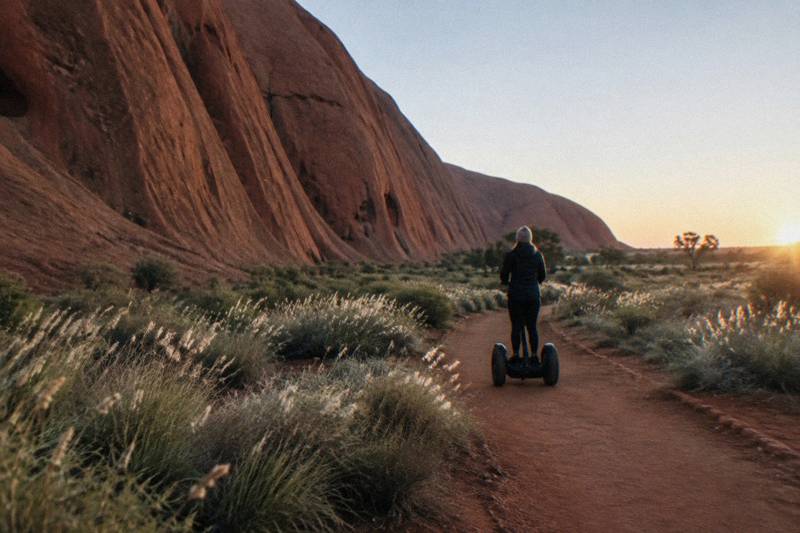
Uluru Segway And Bike Tours: Ride The Base Of The Rock
Two Segway listings cover Uluru's full 10 km base circuit, one riding the whole loop and one mixing riding with guided walking. Here is how they compare on price, duration and format, who each suits, and the honest answer on bike hire.
Short answer
Uluru has two small-group Segway listings from Uluru Segway Tours: the full base loop from A$259 per person (4.9 from 499 reviews, 5 hours) and the Segway plus walking combo from A$219 per person (4.8 from 294 reviews, 4 to 5 hours). Bike hire is not offered on this roster; the alternatives are walking tours and the hop-on hop-off bus.
Riding a Segway around Uluru covers the full 10 km base circuit in a single morning, with a guide, in a small group, and without the footwork the full base walk demands. Two listings from Uluru Segway Tours do this: the full base loop and the Segway plus walking combo. Both are covered here in detail, alongside the walking and bus alternatives, because a Segway is not automatically the right call for every visitor. Uluru Australia Tours compares every listing on the same verified numbers so the choice is based on facts, not brochure language.
One thing this guide will not do is invent a bike operator. Bicycle hire is simply not part of the verified tour roster at Uluru, and pretending otherwise would send readers chasing a product that does not exist. The honest picture: two Segway listings, several walking tours, a hop-on hop-off bus, and that is the real set of wheels on offer.
What A Segway Tour Around Uluru Actually Involves
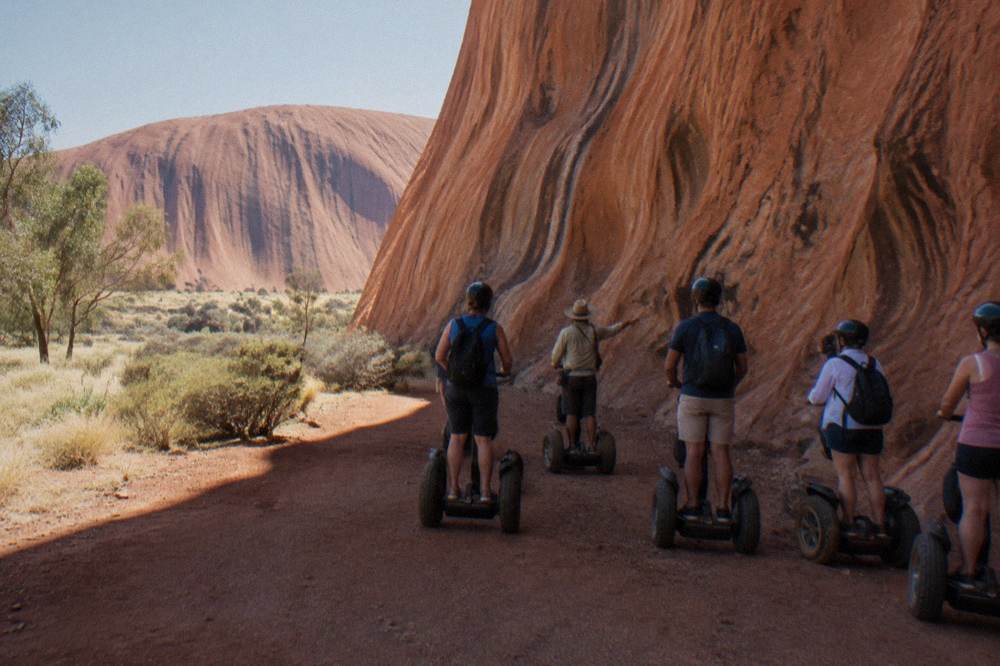
A Segway tour at Uluru is a small-group, guided ride along the base path that rings the rock, covering ground a walker would spend most of a morning on. The full base loop listing runs about five hours from pickup to drop-off, carries a 4.9 rating from 499 reviews, and starts from A$259 per person. Training, the guide and hotel pickup in Yulara are part of the format; the park pass is not.
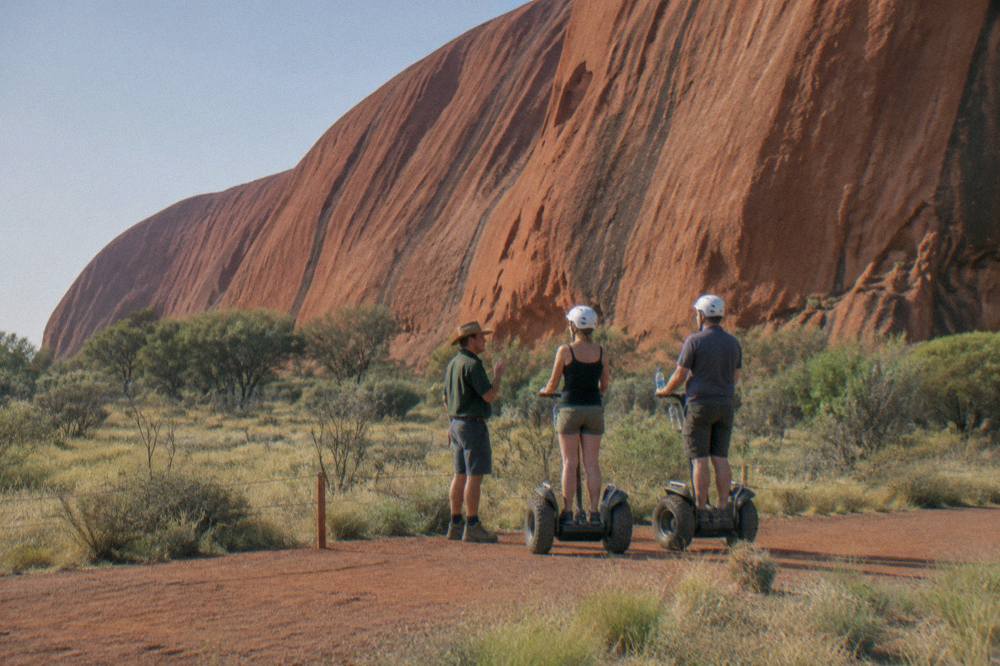
Both Segway listings on the roster are operated by Uluru Segway Tours, and both run as small groups rather than coach loads. The format is closer to the SEIT small-group walking tours than to the large-coach sunrise runs: a guide who stops, explains and answers questions, and a group small enough that nobody is lost at the back. Riders get a briefing and practice time before the ride proper begins, which matters, because the first ten minutes on a Segway feel stranger than the next two hours.
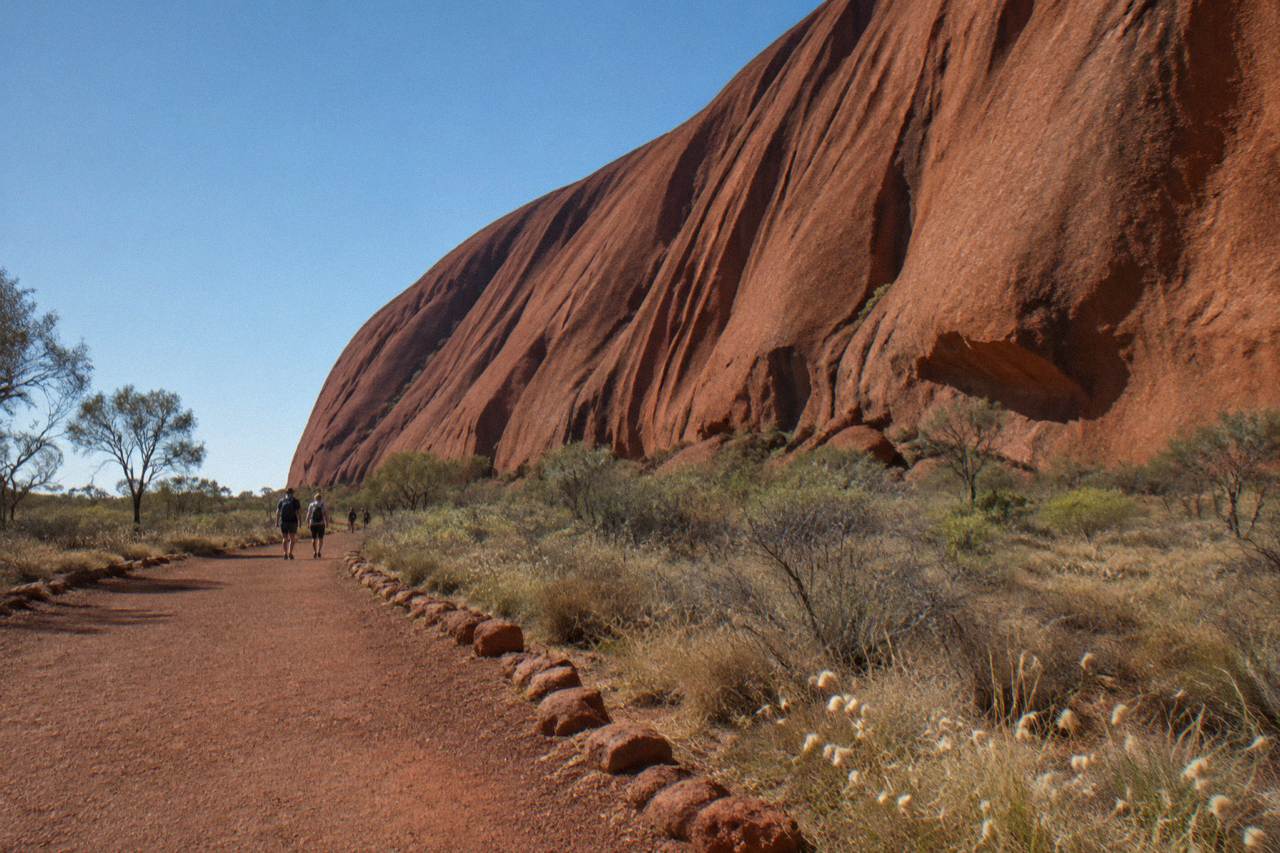
The route is the base itself. Uluru's base walk is about 10 km around the whole circumference, and the park's own walks page recommends starting early and going clockwise from the Mala carpark. A Segway does not change the distance; it changes the effort. What a walker covers in hours of steady footwork, a rider covers with far less strain, and with more attention left over for the guide's commentary on the rock's sections, the Cultural Centre context and the Anangu stories the guides are permitted to share.
A guest review on the full base loop listing captures the beginner worry well: "I wasn't sure I could manage the Segway but it became very comfortable. The team were very helpful and info. So, so pleased we did it!" That is the common arc: hesitation at the practice area, comfort within the first stretch of path. The listing carries a 4.9 rating from 499 reviews, one of the strongest review pools on the entire roster, which says the operator manages that first-timer experience consistently.
Full Base Loop Or The Segway Plus Walking Combo: Which Fits You?
The full base loop (from A$259, 5 hours, 4.9 from 499 reviews) rides the entire base circuit on the Segway. The Segway plus walking combo (from A$219, 4 to 5 hours, 4.8 from 294 reviews) splits the morning between riding and guided walking into the gorges and corners a Segway cannot enter. The loop is for covering ground; the combo is for getting closer on foot.
That is the real difference, and it is worth being blunt about it. A Segway stays on the path; some of Uluru's most rewarding moments are a short walk off it, into Kantju Gorge or along the Kuniya walk to Mutitjulu Waterhole. The combo listing accepts that trade and builds the morning around it: ride the long linking stretches, dismount and walk where walking is the point. The full loop listing instead treats the circumference itself as the experience, and rides it end to end.
| Listing | Decision name | Price from | Duration | Rating | Group format |
|---|---|---|---|---|---|
| Uluru: Segway the FULL base of Uluru | Segway Full Base Loop | A$259 | 5 hours | 4.9 from 499 reviews | Small group on Segways |
| Best of Uluru, Segway and Walking Tour | Segway Plus Walking Combo | A$219 | 4 to 5 hours | 4.8 from 294 reviews | Small group on Segways |
| Full Uluru Base Walk at Sunrise Including breakfast | Full Base Walk, Small Group | A$249 | 6 hours | 4.8 from 460 reviews | Small group on foot |
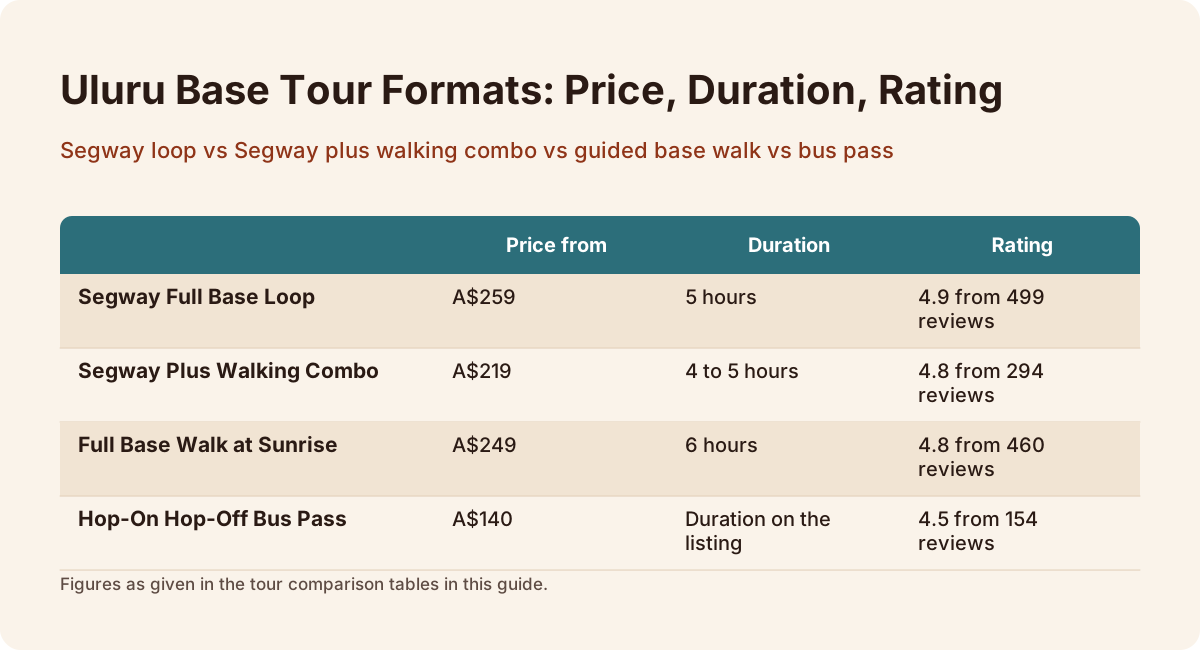
The third row is there deliberately. The full base walk at sunrise with breakfast, from SEIT Tours, costs from A$249 per person, which is only A$10 less than riding the same circumference on a Segway, and it runs an hour longer. Its 4.8 rating from 460 reviews sits level with the combo's. If the choice is really "wheels or boots around the base", that walking tour is the direct competitor, and the Uluru base walk guide breaks down what six hours on foot delivers that five on wheels does not.
Guest reviews suggest the combo lands well with travellers who want both halves of the morning. One recent review reads: "Our guides Holly and Harley were fantastic, very relaxed and knowledgeable, and highly respectful of the local culture. The Segways are so much fun and quite easy to get used to." Respect for culture is not decoration here; the guides' commentary on Anangu country and the signed no-photo zones is part of what the listing sells.
So the fit question is simple. Book the loop if you want the whole circumference and the minimum of walking. Book the combo if you would rather trade some riding time for time inside the gorge sections on foot. Book neither, and take the walking tour, if the Segway itself holds no appeal, because A$249 buys you the same circumference with a breakfast stop.
How The 10 Km Base Ride Compares To Walking It
Walking the full base circuit, about 10 km, takes a good part of the morning at a steady pace; the park advises starting early and finishing before 11.00 am in hot weather. Riding it on a Segway compresses the physical effort dramatically while keeping the same route, the same stops and the same guide time, which is why the two formats cost nearly the same.
The distance figure comes from the park itself: the base walk is about 10 km around the whole circumference. Sections include the Mala walk, the north-east face walk, the Kuniya walk to Mutitjulu Waterhole, the Lungkata walk and the Liru walk linking the Mala carpark with the Cultural Centre. A rider passes all of it; a walker passes all of it. The difference is what your legs feel at Kuniya.
| Factor | Segway Full Base Loop | Full Base Walk (SEIT) | Hop-On Hop-Off Bus Pass |
|---|---|---|---|
| Price from | A$259 | A$249 | A$140 |
| Duration | 5 hours | 6 hours | 1, 2 or 3-day pass |
| Rating | 4.9 from 499 reviews | 4.8 from 460 reviews | 4.5 from 154 reviews |
| Physical demand | Low to moderate | High, 10 km on foot | Minimal |
| Access to gorge walks | Limited | Full | Via your own walking at stops |
The heat arithmetic is where wheels earn their price. The park's safety guidance is to carry at least one litre of water per person per hour of walking and to avoid walking between 2.30 pm and 6.30 pm; the north-east walk closes from 11 am when the temperature reaches 40 C. Both Segway listings run in the morning for exactly this reason. In October, Yulara's average maximum is 32.3 C, and summer months can exceed 35 C daily, so the cool-hours window is not a nicety, it is the whole plan.
A review on the walking tour shows what the on-foot version demands and delivers: "This was an excellent tour. The guide was incredibly knowledgeable and enjoyable. I would highly recommend this wonderful experience." That is a genuine endorsement of the walk, not a knock on the ride. The honest framing is that both work; they just bill different things, effort versus ease.
For readers weighing wheels against a fully independent visit, the free things to do at Uluru guide covers the ranger-guided Mala walk and the viewing areas that cost nothing beyond the park pass. A Segway adds a guide, transport and equipment; the free options add neither, and that is the honest trade.
There is also a middle format worth naming. The hop-on hop-off bus pass, from A$140 per person with a 4.5 rating from 154 reviews, lets you ride between the sunrise area, the Cultural Centre and walk starting points, then walk only the sections you choose. It is the cheapest way to see the base without walking all of it, and it suits visitors whose balance or confidence rules out a Segway entirely. No format here is a winner by default; the decision is effort, budget and how much of the circumference you actually want to complete.
Who A Segway Suits, And Who Should Walk Instead
Segways suit reasonably mobile adults and teenagers who can stand for an hour at a time and manage gentle lean-based steering; no prior experience is needed, and both listings include training. They do not suit visitors with significant balance issues, and anyone uncertain should read the listing's own requirements before booking rather than discovering them at the practice area.
The learning curve is genuinely short, and the reviews say so repeatedly across both listings. The worry people arrive with is balance; the worry they leave with is none. But a Segway still requires standing, still pitches forward and back, and still travels at a pace a footpath mishap could interrupt. If a traveller would hesitate on a bicycle on a gravel track, they should hesitate here too.
Age and weight guidance lives on the operator's listing, not in this guide, and the honest advice is to read it there. What can be said from the roster is the format: small groups, pickup from Yulara hotels, morning departure, about five hours door to door for the loop. That timing matters for families, because the departure is early, and for older travellers, because the Uluru tours for seniors question turns on exactly this kind of demand assessment rather than on age itself.
For visitors who want a guided morning without any wheels, the guided walking tour at sunrise with light breakfast, from AAT Kings at from A$186 per person with a 4.6 rating from 318 reviews, covers sunrise viewing and a guided walk in five and a half coach-based hours. It is the gentlest guided sunrise option on the roster and the natural fallback if the Segway assessment rules a rider out.
The Honest Answer On Bike Hire At Uluru
Bicycle hire is not offered on this site's verified tour roster: there is no bike listing, no bike operator and no bike price to print. Visitors who specifically want two wheels should treat that as a closed option here and choose between the Segway listings, the hop-on hop-off bus or walking, because inventing a bike product would only waste their planning time.
This deserves its own heading because many guides to Uluru hand-wave a bike option into existence. The verified roster contains 25 products across sunrise and sunset tours, Kata Tjuta walks, Field of Light and dining, scenic flights, Segway and cultural tours, and Kings Canyon and multi-day camping. None of them is a bicycle. Rather than pad this section with a fictional alternative, the useful move is to show what the actual non-Segway options are.
| Way to see the base | On the roster? | Price from | Notes |
|---|---|---|---|
| Segway full base loop | Yes | A$259 | Whole circumference, guided, 5 hours |
| Segway plus walking combo | Yes | A$219 | Riding mixed with guided gorge walking |
| Guided full base walk | Yes | A$249 | 10 km on foot, breakfast, 6 hours |
| Hop-on hop-off bus | Yes | A$140 | Self-paced stops, walk what you choose |
| Independent base walk | Yes, free | Park pass only | About 10 km, start early |
| Bicycle hire | No | n/a | Not on the roster; do not plan around it |
The park itself is built around walking and vehicles, and the infrastructure reflects that: car parks at each walk start, a sealed loop road, and the base path itself. The things to do in Uluru guide maps the full set of actual options, all of which exist and can be planned around today.
Prices, Times And What The Segway Listings Include
The full base loop starts from A$259 per person for about 5 hours; the combo starts from A$219 for 4 to 5 hours. Both include pickup in Yulara, the guide and the Segway; the $38 adult park pass is separate, exactly as the listing states, and both listings allow free cancellation with a cutoff that varies, so read the booking page for the exact window.
The "from" matters. Prices on this roster vary by date and group size, and the figure printed here is the listing's own floor. The price gap between the two Segway listings is A$40 at the floor, which is small enough that the format decision should drive the booking, not the price. Paying A$40 more to ride the whole circumference, or A$40 less to add gorge walking, are both defensible calls.
| Cost item | Amount | Paid to | Included in tour price? |
|---|---|---|---|
| Segway Full Base Loop | From A$259 | The listing | n/a |
| Segway plus walking combo | From A$219 | The listing | n/a |
| Park pass, adult 3 days | $38 | Parks online, in advance | No, stated separately |
| Park pass, under 18 | Free | Parks online | No charge |
The park pass is worth a paragraph of its own because it catches people out. Every tour listing on this roster states the fee separately and says it must be pre-purchased online; it is $38 for an adult for 3 days, under 18 free, valid for Uluru-Kata Tjuta National Park only. Buy it, save the QR code to your phone, and scan it at the entry station. The national park pass guide walks through the details, including the $50 annual option if your dates stretch past three days.
Cancellation is the other detail that varies by listing, and this site does not generalise it. Both Segway listings allow free cancellation with cutoffs stated on the booking page. Compare that with the SEIT small-group walking tours, which list cutoffs of several days on some rows, and the difference is real money if your plans are loose. Read the specific listing's policy before you pay, not a summary.
Safety, Heat And Photography Rules On The Ride
The park's own safety rules apply to riders as much as walkers: carry at least one litre of water per person per hour, avoid exertion between 2.30 pm and 6.30 pm, and know that emergency help is 000 or 112. Culturally sensitive sections of the base are signed no-photo zones, and guides will point them out; wide shots of Uluru from a distance are fine, close detail of the signed sites is not.
The Segway listings sidestep most heat risk by running in the morning, but riders still need water, sun protection and awareness. UV at Uluru is extreme in the warm months, and the Bureau of Meteorology's guidance is reflected in the park's advice to plan outdoor time for the early hours. The rules are not bureaucratic fine print; they are the difference between a comfortable morning and a ruined one.
Photography is the other rules area worth knowing before the ride. The park's photography page is explicit: culturally sensitive sites at Uluru and Kata Tjuta are clearly signed, and photographing those specific sites is prohibited, while wide shots of Uluru from a distance are fine. On the north-east face, Anangu ask for wide shots only, with nothing showing the detail on the top-left side; the best light for that stretch is one to two hours before sunset when shadows obscure the sensitive areas. Drones are prohibited throughout the park under the EPBC Act, with penalties. For the fuller picture of what can and cannot be photographed, see whether it is illegal to photograph Ayers Rock.
| Rule | Detail | Source |
|---|---|---|
| Water | At least 1 litre per person per hour of activity | Park safety page |
| Heat window | Avoid walking 2.30 pm to 6.30 pm | Park safety page |
| 40 C closures | North-east walk closes from 11 am at 40 C | Park walks page |
| Emergency | 000 or 112; emergency radios on most walks | Park safety page |
| Photos | Signed sensitive sites: no photographs; wide shots fine | Park photography page |
| Drones | Prohibited under the EPBC Act, penalties apply | Park photography page |
Guides on both Segway listings repeat these rules on the ground, and the reviews suggest they do it well; the respect for local culture noted in guest reviews is part of the product, not a legal disclaimer bolted on. Riders who follow the guide's calls on where to stop shooting will have no trouble, and will come home with wide shots of the rock that are both legal and, in the early light, genuinely good.
Planning Your Morning Around The Segway Departure
Both Segway listings include pickup from Yulara hotels and run about five hours door to door, which means an early start and a late-morning finish. Pair that with the park's October hours of 5.00 am to 8.00 pm, and the practical plan is one Segway morning, one Kata Tjuta morning, and one relaxed afternoon elsewhere rather than stacking two big mornings back to back.
The reason not to stack is simple fatigue math. A 5 am pickup followed by a 5-hour ride is a full day's effort even sitting down, and the next morning's Kata Tjuta option, such as the small-group sunrise tour with breakfast at from A$249, is another early start. Travellers with three days, the usual sweet spot for Uluru, do better alternating. The how many days are enough for Uluru question is answered in detail there, but the short version for riders is: two activity mornings, not three.
Booking timing also matters. The Segway listings are small-group by format, which means fewer seats per departure than the large-coach sunrise tours. In the May to September peak, when daytime maximums sit in the 20 to 30 C band that makes desert activity pleasant, small groups fill first. The free-cancellation terms printed on both listings make an early booking low-risk: reserve the seat, read the cutoff, and adjust if plans move.
For the second or third day, the hop-on hop-off pass shown above is the complement that works with, not against, a Segway morning. Ride the guided loop on day one; use the bus on day two to revisit whichever corner of the base the ride passed too quickly, whether that is the Cultural Centre, open 7.00 am to 5.45 pm daily, or a longer linger at Mutitjulu Waterhole. The full range of guided options across every format is in the sunrise and sunset tours hub, and the cultural depth sits in the Aboriginal culture at Uluru guide.
The last practical note is season. Winter mornings at Yulara average 5.6 C in June and 4.4 C in July, cold enough that layers matter for a 5 am pickup, while summer brings heat that narrows every safe window. May to September is the band the park's own "when to come" advice favours, and it is the band the Segway format is built around. Whenever you go, conditions change, so read the park's news page before travelling.
Common Questions About Uluru Segway And Bike Tours
How much do Uluru Segway tours cost?
The full base loop starts from A$259 per person for about 5 hours, and the Segway plus walking combo starts from A$219 for 4 to 5 hours. The $38 adult park pass is separate, exactly as the listings state, and must be pre-purchased online.
Can you ride a Segway all the way around Uluru?
Yes, that is exactly what the full base loop listing does: the whole roughly 10 km circumference with a guide, in a small group, in about 5 hours including pickup and training. The combo listing instead mixes riding with guided walking in the gorge sections.
Can you hire bikes at Uluru?
Not through this site's verified roster. There is no bicycle listing, no bike operator and no bike price to quote. The real alternatives are the two Segway listings, the hop-on hop-off bus pass from A$140, guided walking tours, or the free independent base walk with a park pass.
Is a Segway tour at Uluru hard if you have never ridden one?
Guest reviews on both listings say no. One verbatim review reads: "I wasn't sure I could manage the Segway but it became very comfortable." Training is included before the ride begins, though riders do need to stand for extended periods and manage lean-based steering.
Which is better at Uluru, Segway or walking the base?
They cost almost the same: from A$259 to ride the loop versus from A$249 for the 6-hour guided full base walk with breakfast. The ride suits travellers who want the full circumference with less effort; the walk suits those who want more time on foot inside the gorges. Ratings are close, 4.9 from 499 reviews for the loop against 4.8 from 460 for the walk.
Do Uluru Segway tours include the park pass?
No. The listings state the park entry fee separately, and it must be pre-purchased online: $38 for an adult for 3 days, under 18 free. The pass is scanned at the entry station, so save the QR code to your phone or print it.