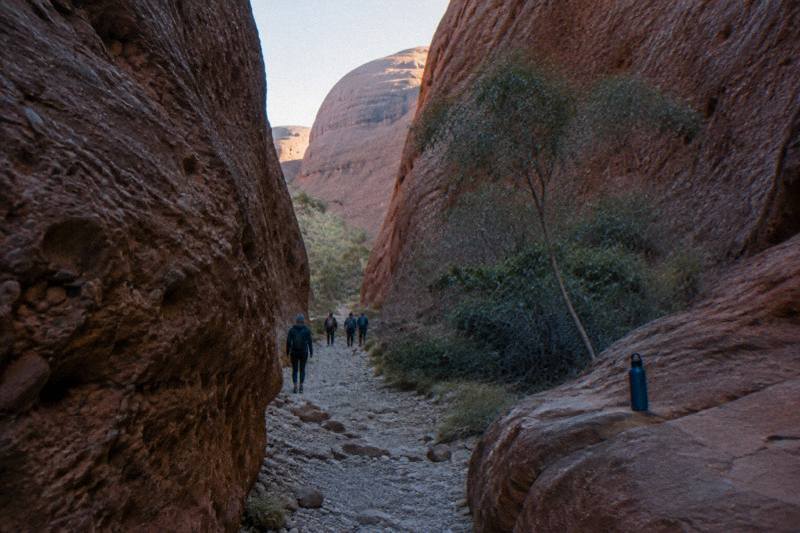
Things To Do In Uluru: Walks, Light Shows And Tours
Uluru concentrates a surprising range of activity into a small area: a 10 km base walk, the 36 domes of Kata Tjuta 50 km away, five purpose-built viewing areas, an installation of more than 50,000 lights, and a roster of tours running from a 15-minute helicopter loop to four-day camping trips.
Short answer
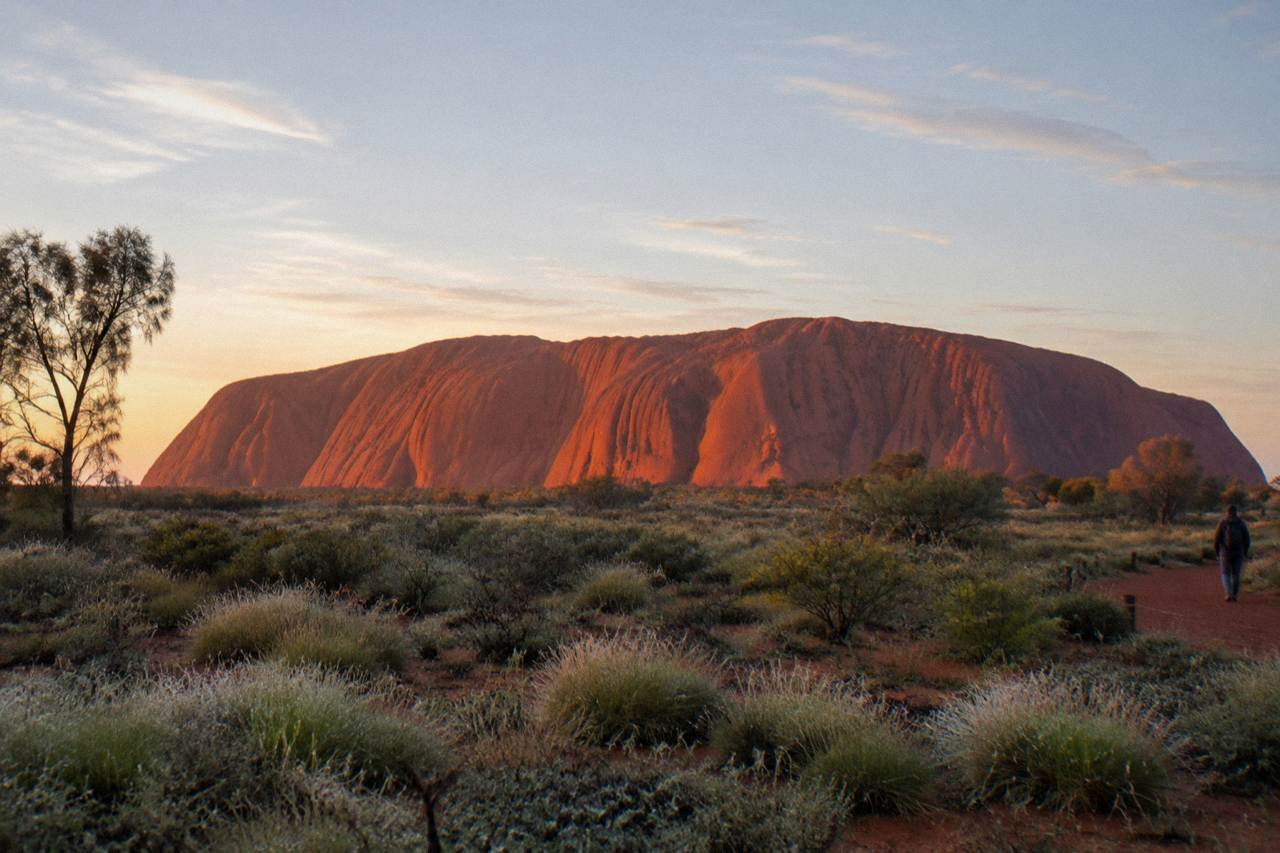
The core things to do in Uluru are the 10 km base walk, the Kata Tjuta walks 50 km away, free sunrise and sunset viewing areas, the Cultural Centre, the Field of Light installation, and scenic flights. A 3-day park pass costs $38 for an adult, and roster tours run from A$115 per person for the Field of Light sunrise tour to A$1,195 for a four-day camping adventure.
Uluru is one of the few Australian landmarks where the activities on offer span nearly every format travel can take. You can walk the full 10 km circuit around the rock on your own two feet, ride it on a Segway, circle it in a helicopter in 15 minutes, watch 50,000 solar-powered spheres light up the desert floor after dark, or spend four days camping through Uluru, Kata Tjuta and Kings Canyon. The park itself, run jointly by Anangu Traditional Owners and Parks Australia, supplies the free infrastructure: walking tracks, five dedicated sunrise and sunset viewing areas, and a Cultural Centre open 7.00 am to 5.45 pm daily.
This guide lays out the full activity menu, category by category, with the prices, durations and ratings from this site's verified tour roster plus the park's own published figures. Every tour category hub on Uluru Australia Tours is linked below so you can drill into whichever format fits your trip.
What Can You Actually Do At Uluru?
The activities at Uluru group into seven broad families: walking the base of the rock and its linked sections, walking at Kata Tjuta 50 km west, free ranger and Cultural Centre experiences, sunrise and sunset viewing from five designated areas, the after-dark Field of Light and dining shows, scenic flights, and guided formats such as Segway, cultural homelands visits and multi-day camping tours. Everything departs or begins from Yulara except one two-day camping tour from Alice Springs. For the cultural side of the rock, our guide to Aboriginal culture at Uluru covers the Cultural Centre, ranger walks and guided experiences in detail.
That spread matters for planning because the formats overlap very little. A walker who completes the full base circuit has seen the rock at ground level; a helicopter passenger has seen its scale from above; a guest at Field of Light has seen the desert floor transformed after dark. None of them replaces the others, and most visitors combine two or three across a two or three night stay. The practical constraint is heat: the park advises against walking between 2.30 pm and 6.30 pm and recommends carrying at least one litre of water per person per hour, with emergency contact at 000 or 112.
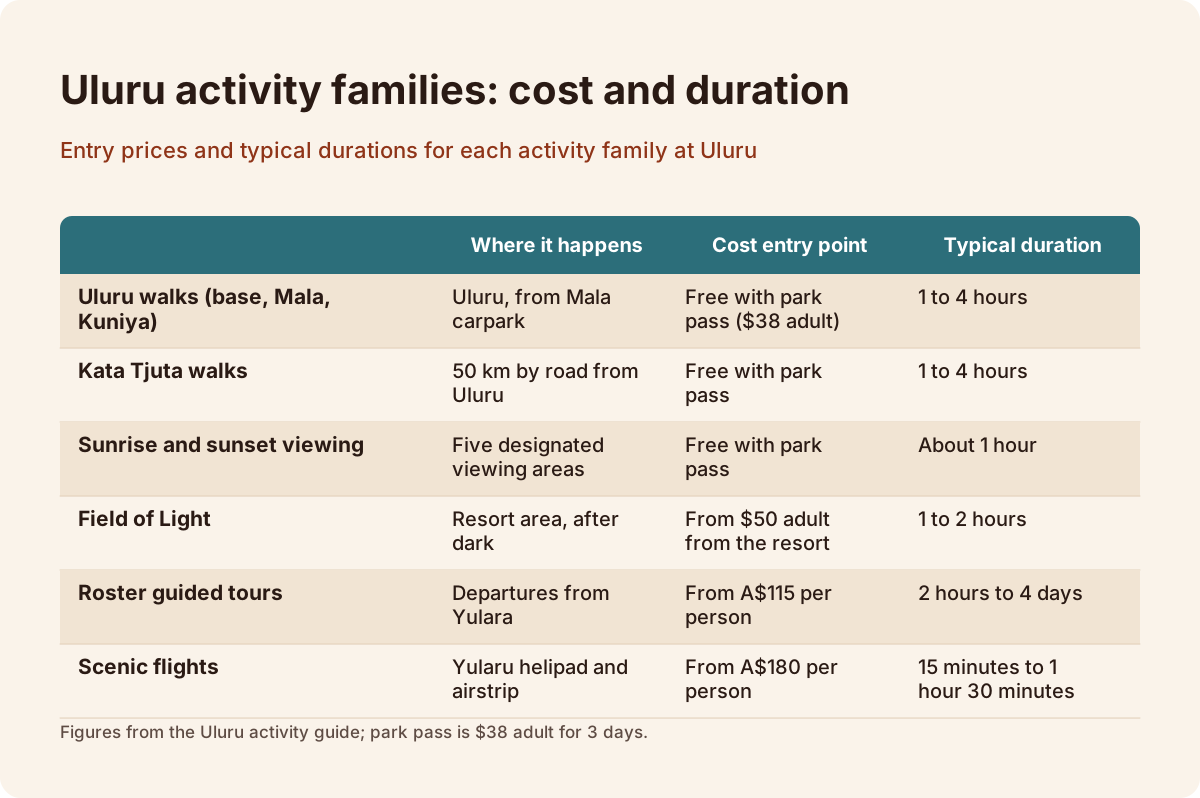
| Activity family | Where it happens | Cost entry point | Typical duration |
|---|---|---|---|
| Uluru walks (base, Mala, Kuniya) | Uluru, from Mala carpark | Free with park pass ($38 adult, 3 days) | 1 to 4 hours |
| Kata Tjuta walks | 50 km by road from Uluru | Free with park pass | 1 to 4 hours |
| Sunrise and sunset viewing | Five designated viewing areas | Free with park pass | About 1 hour |
| Field of Light | Resort area, after dark | From $50 adult direct from the resort | 1 to 2 hours |
| Roster guided tours | Departures from Yulara | From A$115 per person | 2 hours to 4 days |
| Scenic flights | Yulara helipad and airstrip | From A$180 per person | 15 minutes to 1 hour 30 minutes |
The park pass itself is the one cost nobody escapes. An adult 3-day pass is $38, an annual pass is $50, and under 18s enter free. Tour listings state the fee separately, so budget for it on top of any tour price. The pass covers Uluru-Kata Tjuta National Park only, and the park's pass page explains the online purchase and QR-code entry process. Our Uluru National Park Pass guide walks through the details.
How Does The Uluru Base Walk Work?
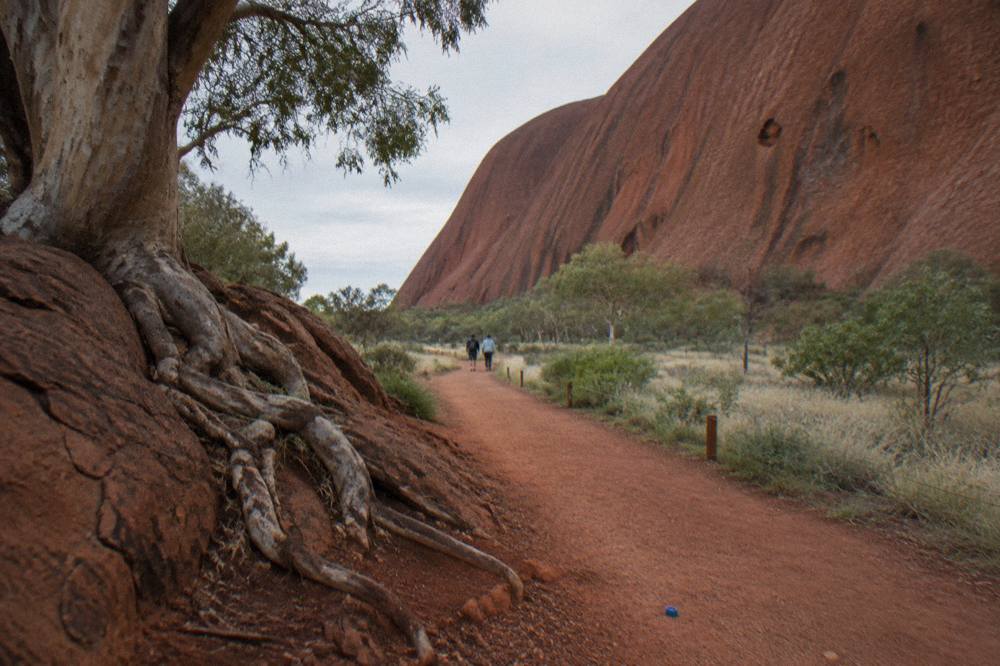
The Uluru base walk is a roughly 10 km loop around the entire circumference of the rock, started from the Mala carpark in the early morning and walked clockwise; the park advises finishing before 11.00 am in hot weather. It is free once you hold a park pass, and it links shorter signed sections including the Mala walk, the North-east face walk, the Kuniya walk to Mutitjulu Waterhole and the Lungkata walk.
The base walk is the deepest way to experience the rock without a guide. The Mala walk section, 2 km return to Kantju Gorge, is wheelchair accessible and has drinking water available, making it the most manageable slice for families and anyone limiting distance. The Kuniya walk reaches Mutitjulu Waterhole, one of the few places where permanent water sits right against the rock. Two rules shape the walk: culturally sensitive sites are clearly signed and photographing them is prohibited (wide shots of Uluru itself from a distance are fine), and sections close in extreme heat, with the North-east walk closing from 11 am when the temperature reaches 40 C. The park's own walks page prints the full section list and heat rules.
Two roster tours convert the base walk from a solo effort into a guided small-group experience. The Full Base Walk, Small Group tour by SEIT Tours runs the complete circuit at sunrise with breakfast included, from A$249 per person, rated 4.8 from 460 reviews, with free cancellation listed six days before start. One guest review reads: "This was an excellent tour. The guide was incredibly knowledgeable and enjoyable. I would highly recommend this wonderful experience."
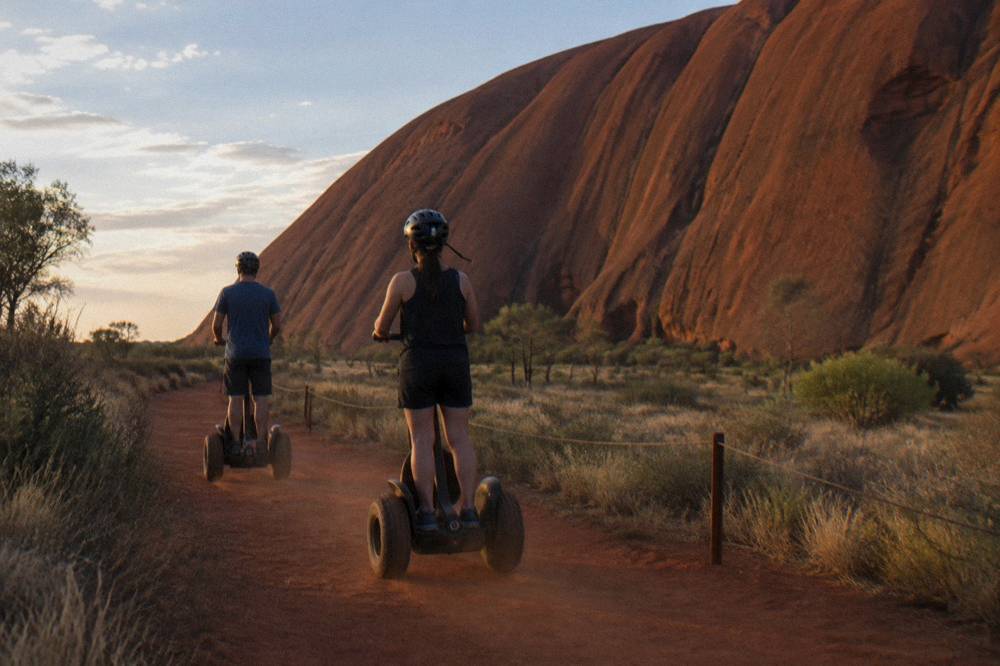
For a faster loop with the same guide-and-commentary benefit, the Segway Full Base Loop by Uluru Segway Tours covers the whole base on two wheels in a five-hour small-group format, from A$259 per person and rated 4.9 from 499 reviews. A review from a first-time rider captures the appeal: "I wasn't sure I could manage the Segway but it became very comfortable. The team were very helpful and info. So, so pleased we did it!" More detail on both walking and rolling options sits in the Uluru base walk guide.
Where Do You Watch Sunrise And Sunset?
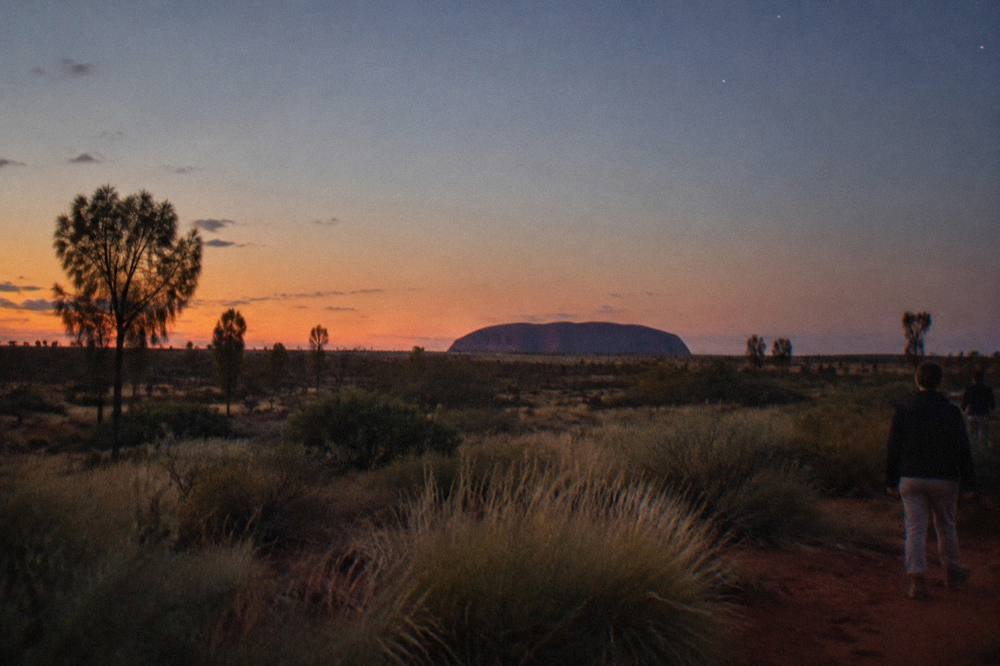
The park maintains five dedicated viewing areas: Talinguru Nyakunytjaku and the Kata Tjuta dune for sunrise, and the Uluru car sunset area, the Uluru bus sunset area and the Kata Tjuta sunset area for sunset. All five are free to enter with a park pass, drivable or served by tour coaches, and the park opens every day of the year with hours that shift by month, for example 5.00 am to 8.00 pm in October.
Because the viewing areas sit inside the park, the opening hours govern your window. Hours range from 5.00 am openings in the summer months to 6.30 am openings in June and July, and everyone must leave by closing time. The park's sunrise and sunset page lists all five areas. For a deeper comparison of the two experiences, read is Uluru better for sunrise or sunset.
| Viewing area | Best for | Access style |
|---|---|---|
| Talinguru Nyakunytjaku | Sunrise over Uluru | Raised platform, car and coach parking |
| Kata Tjuta dune | Sunrise with Kata Tjuta | Short dune walk |
| Uluru car sunset area | Sunset, independent travellers | Drive in |
| Uluru bus sunset area | Sunset, tour groups | Coach setdown |
| Kata Tjuta sunset area | Sunset over the domes | Drive in, 50 km from Uluru |
Most roster tours are built around these two windows. The most efficient single-day option is the Bus Sunrise, Kata Tjuta Combo by AAT Kings, which pairs the Uluru sunrise viewing area with a Kata Tjuta visit in a five-hour coach trip from Yulara, from A$186 per person and rated 4.6 from 603 reviews. The sunrise and sunset tours hub compares every coach, small-group and walking variant on the roster.
The two above show the formats first-time visitors most often combine: a coach sunrise combo and a hop-on hop-off pass. Every listing shows free cancellation, but the cutoff differs tour to tour, so read the booking page before you commit.
What Is Kata Tjuta And Why Do Tours Pair It With Uluru?
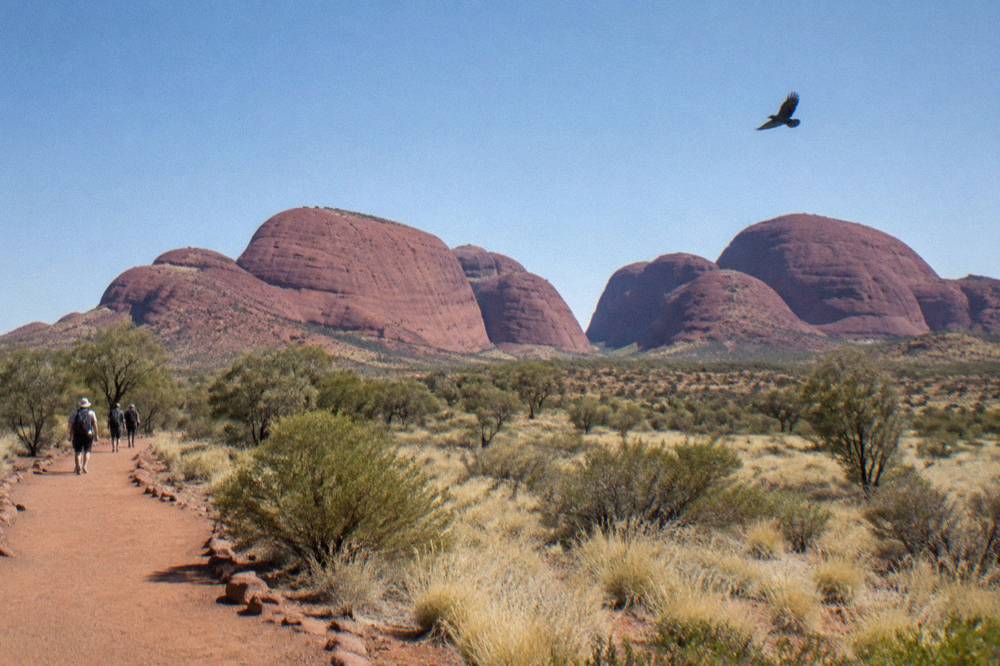
Kata Tjuta, formerly known as the Olgas, is a group of 36 steep-sided domes covering more than 20 square kilometres and rising up to 546 metres above the plain, which makes its highest dome taller than Uluru's 348 metres. It sits 50 km by road from Uluru, and its two main walks are the Grade 4 Valley of the Winds circuit, 3 to 4 hours, and the shorter Walpa Gorge walk.
The name is a Pitjantjatjara term meaning "many heads", and the site is governed by its own photography rules: no photographs or video of the Kata Tjuta formations along the Valley of the Winds walk, though close-ups of flora, fauna and people are welcome. The full circuit passes the Karu lookout at about 1 hour in and the Karingana lookout at about 2.5 hours, giving walkers graded exit points if the heat or the grade gets the better of the day. More walk detail, including the lookouts and grading, is in the Valley of the Winds walk guide.
Four roster tours cover Kata Tjuta directly, from the 3-Hour Afternoon Walpa Gorge small-group tour at from A$185 per person to the sunrise small-group tour with breakfast at from A$249, rated 4.8 from 255 reviews. One guest on that sunrise tour wrote: "Beautiful way to wake up. The sunrise was a magical experience and the hike through the gorge was stunning. Andy was a great guide and having a light breakfast was fun." The full set is compared on the Kata Tjuta tours hub.
What Happens After Dark At Uluru?
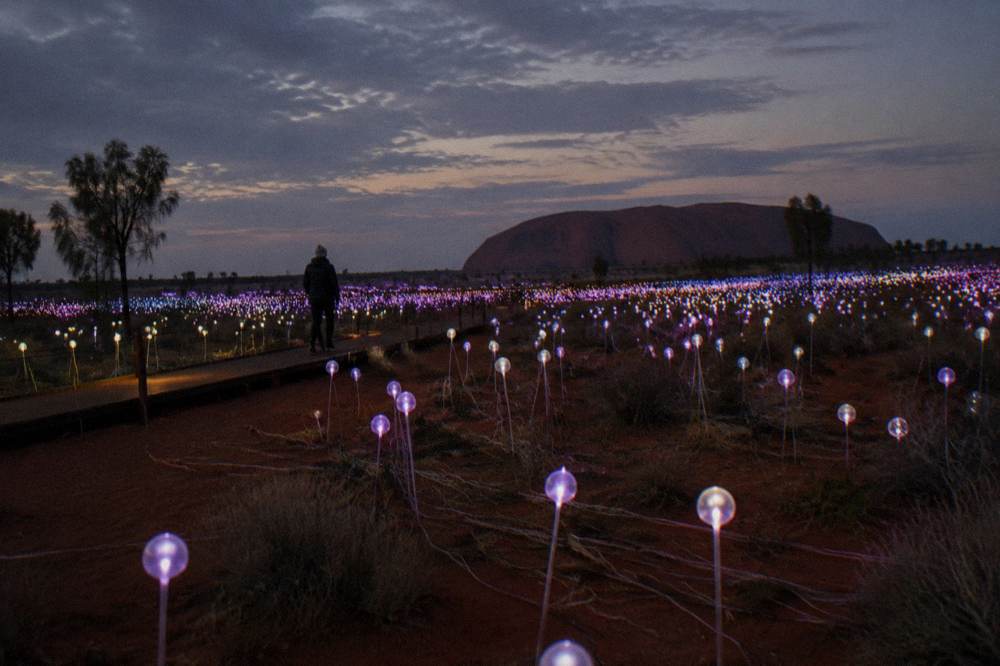
After dark the activity shifts to light shows and dining: Field of Light, an installation of more than 50,000 solar-powered spheres by artist Bruce Munro, has run since 2016 and is extended through 2029, while the resort's Wintjiri Wiru show tells the Mala story with 1,200 drones, lasers and projection. Field of Light General Admission is from $50 adult and $39 child direct from Ayers Rock Resort.
Sounds of Silence, a four-hour dining experience for ages 10 and over, runs from $295 adult, and Tali Wiru, for ages 16 and over from April to October, runs from $455 adult; both are sold direct by the resort. Field of Light spreads across an area the resort describes as larger than seven football fields, with 2026 marking its 10-year anniversary. Because these four products, Field of Light passes, Wintjiri Wiru, Sounds of Silence and Tali Wiru, are sold direct by Ayers Rock Resort, they carry no booking card or link here; the resort's own pages handle those sales. The one roster-listed light-show tour is the Field Of Light Sunrise, Hot Drinks tour by AAT Kings, from A$115 per person and rated 4.6 from 677 reviews, which visits the installation at dawn with hot drinks included rather than after dark.
| Night experience | Operator or seller | Price (from, per adult) | Season |
|---|---|---|---|
| Field of Light General Admission | Ayers Rock Resort, direct | $50 | Year round |
| Field of Light Star Pass | Ayers Rock Resort, direct | $137 | Year round |
| Field of Light Dinner | Ayers Rock Resort, direct | $360 | Year round |
| Wintjiri Wiru Twilight | Ayers Rock Resort, direct | $210 | Twilight year listing; After Dark 1 Apr to 30 Sep |
| Sounds of Silence | Ayers Rock Resort, direct | $295, ages 10+ | Year round |
| Tali Wiru | Ayers Rock Resort, direct | $455, ages 16+ | April to October |
| Field Of Light Sunrise, Hot Drinks | AAT Kings, roster listing | A$115 | Year round |
Resort prices shown are for travel 1 April 2026 to 31 March 2027 as printed by the resort. The deeper dive into the installation itself, including what a visit actually looks like at ground level, is the Field of Light Uluru guide.
Is A Scenic Flight Over Uluru Worth Adding?
Scenic flights are the only way to take in both Uluru and Kata Tjuta in a single view, and the roster offers three helicopter options plus one fixed-wing flight: the 15-minute Uluru helicopter from A$195 per person, the 25-minute two-site helicopter from A$315, a 36-minute sunset helicopter from A$415, and the Scenic Plane Flight: Uluru Rock Blast from A$180.
The ratings across the four listings run from 4.8 to 4.9 with review counts between 113 and 669. The fixed-wing option is the cheapest way airborne and carries the longest total duration at 1 hour 30 minutes. A guest review on that listing reads: "Fun and affordable way to see Ayers Rock. Ryan was an amazing pilot and made me feel very safe and comfortable during this flight." At the other end, the 25-minute helicopter covers both rock sites and holds a 4.8 rating from 616 reviews. The 15-minute flight is the one most often added to a land-based day, and a guest on it noted that "being able to view Uluru by air gave a true perspective of the size." Weather and operations decide whether a flight runs, so keep a flexible day where possible. Full comparisons live on the Uluru helicopter flights hub.
What About Segways, Culture And Kings Canyon?
Beyond the walks and flights, three more activity families fill out an Uluru trip: Segway tours from A$219 per person that cover the base with far less effort than walking, the Aboriginal Homelands Experience by SEIT Tours at from A$399, a full-day small-group visit to private Aboriginal land with an Anangu guide, and Kings Canyon day tours from A$345 or multi-day camping trips from A$765.
Together those three families turn a two-night stop into a full outback itinerary, and the cultural experiences deserve particular weight in any plan. Uluru is Anangu country, the climb has been closed permanently since 26 October 2019, and the Cultural Centre at the park, free to enter, is the best place to start understanding why. The ranger-guided Mala walk, free for park visitors, runs at 8.00 am from October to April and 10.00 am from May to September. The Aboriginal Homelands Experience is the roster's deepest cultural product; a guest review reads: "This tour is a true privilege to spend time on private Aboriginal land with an Anangu guide sharing stories. The experience is just so phenomenal culminating in a stunning sun set and nibbles."
Kings Canyon sits a long drive away and is best reached on a dedicated tour. The Kings Canyon Rim Walk Day by AAT Kings is a 12-hour coach day from A$345, rated 4.7 from 666 reviews, while the camping options, including a 4-Day Camping Adventure from A$1,195 rated 4.9 from 355 reviews, bundle all three icons with swag nights under the stars. Those are compared on the Uluru and Kings Canyon tours hub and the multi-day camping guide.
How Many Activities Fit Into Your Trip Length?
One night fits a single viewing area plus one short tour, such as the 2-hour Field of Light sunrise or the 15-minute flight; two nights cover the base walk plus a Kata Tjuta or sunset tour; three nights comfortably add Kings Canyon or a second-format experience, since heat and distances, not interest, set the real limits.
Distances surprise people. Kata Tjuta is 50 km by road from Uluru, Kings Canyon is a 12-hour round trip day, and the park itself closes overnight, with everyone required to be out by closing time. In the warmer months the practical walking window is the morning only. Season matters too: May to September brings daytime maximums usually between 20 and 30 C, while October to March can exceed 35 C daily. The best time to visit Uluru guide carries the full climate table.
| Trip length | Realistic activity mix | Roster tours that fit |
|---|---|---|
| One night | Sunrise viewing, base walk section, one short tour | 3-Hour Highlights, Field of Light Sunrise, 15-minute helicopter |
| Two nights | Full base walk or Segway loop, Kata Tjuta tour, sunset dinner tour | Bus Sunrise Combo, Valley Of The Winds Hike, Sunset BBQ Day Tour |
| Three nights | Everything above plus Kings Canyon day or cultural full day | Kings Canyon Rim Walk Day, Aboriginal Homelands |
| Four days or more | Camping itinerary through all three icons | 3-Day or 4-Day Camping, 2-Day from Alice Springs |
Budget-wise, the honest floor for a touring day at Uluru is the hop-on hop-off bus pass at from A$140 per person, with guided roster tours clustering between A$185 and A$399 and camping trips from A$765. The how much does an Uluru tour cost breakdown prices every family out. Whatever you pick, the park pass is separate and must be pre-purchased online before you arrive at the entry station.
Which Uluru Activities Should You Book Before You Arrive?
Book before you arrive anything with a seat count or a season: the small-group tours cap their numbers, the 4.8-rated base walk and Kata Tjuta small-group tours list cancellation cutoffs of six days before start, and resort-direct dining experiences such as Tali Wiru only run April to October. The coach tours with 24-hour cutoffs, the hop-on hop-off pass and the park pass itself can wait until your plans firm up.
The pass must still be bought online before the entry station, so nothing is fully spontaneous. Cancellation terms are the detail most worth reading. Most roster listings allow free cancellation, but the cutoffs genuinely differ tour by tour: the Bus Sunrise Combo and the Field of Light Sunrise tour list 24 hours, the SEIT small-group sunset tour lists 3 days, the base walk and Kata Tjuta sunrise tours list 6 days, and the two-day Alice Springs camping tour lists 14 days. Never assume a blanket rule; the booking page for each specific tour states its own cutoff.
For a one-tour trip, the Bus Sunrise, Kata Tjuta Combo remains the sensible default: it touches the sunrise viewing area, Kata Tjuta and a guided commentary in five hours from A$186 per person, leaving the rest of your day free for a flight, a walk or the light show. Its listing is here: Bus Sunrise, Kata Tjuta Combo tour page.
Common Questions About Things To Do In Uluru
What are the best things to do in Uluru in one day?
Start at the Talinguru Nyakunytjaku sunrise viewing area, walk the Mala section of the base walk in the cool of the morning, visit the free Cultural Centre, and finish with either a sunset viewing area or the Outback BBQ Dinner and Star Talk tour from A$328 per person. The Bus Sunrise, Kata Tjuta Combo covers both rock sites in one five-hour trip if you want a guide throughout.
Can you visit Uluru without a tour?
Yes. The base walk, the Kata Tjuta walks, the five viewing areas, the Cultural Centre and the ranger-guided Mala walk are all free once you hold a park pass, which costs $38 for an adult for 3 days. A rental car or the hop-on hop-off bus pass from A$140 per person covers the distances, since Kata Tjuta is 50 km by road from Uluru.
How much do Uluru activities cost?
Independent activities cost the $38 adult park pass and nothing more. Roster guided tours run from A$115 per person for the Field of Light Sunrise tour to A$1,195 for the four-day camping adventure. Resort-direct experiences run from $50 adult for Field of Light General Admission to $455 adult for Tali Wiru, sold direct by Ayers Rock Resort.
Is Field of Light still running?
Yes. The installation has run since 2016, 2026 marks its 10-year anniversary, and it has been extended through 2029. General Admission is from $50 adult and $39 child direct from the resort, and the roster's AAT Kings sunrise tour with hot drinks runs from A$115 per person.
What can you do at Uluru with kids?
Under 18s enter the park free, the Mala walk is wheelchair accessible with drinking water available, and the Cultural Centre is free to enter. Coach tours such as the Bus Sunrise Combo and the Field of Light Sunrise tour take children, while Sounds of Silence requires ages 10 and over and Tali Wiru requires 16 and over.
Do you need to book Uluru tours in advance?
Small-group tours cap numbers and some list cancellation cutoffs of three, six or more days before start, so book those early, especially in the May to September peak. Coach tours with 24-hour cutoffs are more forgiving, but every tour's own listing page states its exact terms, so read it before you plan around flexibility.