Does It Get Cold At Night In Uluru?
Yes, winter nights at Uluru regularly drop near freezing. The BoM averages, what it means for sunrise tours, camping and Field of Light, and how to pack for desert nights.
Does It Get Cold At Night In Uluru?
Yes, it gets genuinely cold, and most of the year the drop is sharp. Winter nights in June and July average lows of 5.6 and 4.4 degrees Celsius at Yulara, and frosts on the sand are a normal winter event. Summer nights are mild to warm, averaging near 21 to 23 degrees, but every night of the year is cooler than the day by a wide margin because desert air holds almost no moisture.
The numbers behind that answer come from the Bureau of Meteorology averages published on the park's own planning pages, which print a full monthly table for Yulara. The site's climate guidance adds one line that surprises visitors from humid climates: overnight temperatures in winter can be very cold. That phrasing comes from the official best time to visit page, and it is not an exaggeration. A June afternoon of 20 degrees can finish the night close to zero.
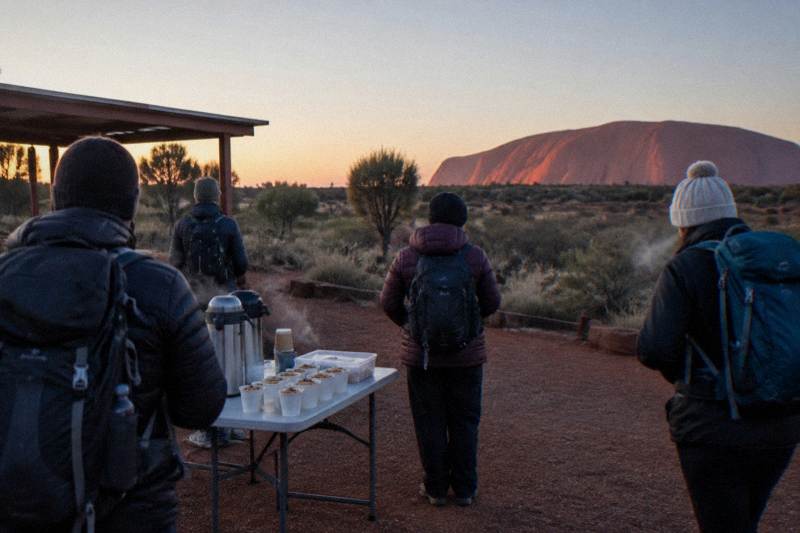
The practical point for a visitor is that cold at Uluru is not a constant, it is a swing. The same dry air that lets the temperature plunge after sunset also lets it climb fast after sunrise, so a single morning can move through three sensible layers of clothing before lunch. Anyone booked on a pre-dawn departure, whether the Field of Light Sunrise Tour with Hot Drinks, the Bus Sunrise, Kata Tjuta Combo or a small-group base walk, will stand still outdoors in the coldest hour of the day. For specific advice on layers, footwear and fly protection, see our guide to dressing for Uluru's Field of Light.
That is the short answer, and the rest of this article unpacks it month by month: which nights are actually cold, why the desert works this way, what the cold means for camping tours and night-time experiences, and exactly how to dress so the cold does not cost you the sunrise.
What Do The Monthly Night Temperatures Actually Look Like?
The Yulara averages run from a mean minimum of 4.4 degrees in July, the coldest month, to 22.8 degrees in January, the warmest. Six months of the year, May through October, post average lows below 15 degrees, and the three winter months of June, July and August all average below 6.2. Only the height of summer, December to February, keeps nights reliably above 20.
Those figures are the Bureau of Meteorology monthly averages for Yulara as printed on the park's planning pages. The full minimum-temperature picture looks like this:
| Month | Mean minimum (C) | Mean maximum (C) | Mean rain (mm) |
|---|---|---|---|
| January | 22.8 | 38.4 | 28.8 |
| February | 22.1 | 37.0 | 38.4 |
| March | 19.3 | 34.5 | 32.6 |
| April | 14.5 | 29.9 | 15.7 |
| May | 9.3 | 24.3 | 14.3 |
| June | 5.6 | 20.4 | 18.2 |
| July | 4.4 | 20.6 | 17.6 |
| August | 5.9 | 23.7 | 5.0 |
| September | 10.7 | 28.7 | 9.0 |
| October | 14.9 | 32.3 | 21.1 |
| November | 18.4 | 35.1 | 33.1 |
| December | 20.8 | 36.5 | 45.5 |
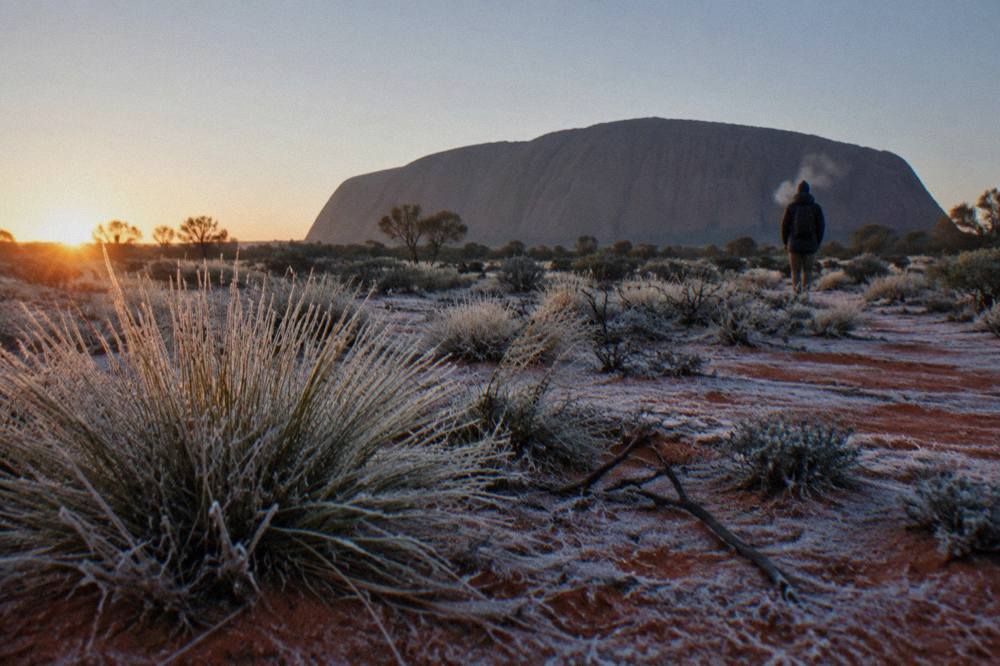
Two readings of that table matter. First, the averages understate the extremes: a mean minimum of 4.4 degrees in July sits alongside individual nights at or below zero, and frost on the spinifex plains is a regular winter sight. Second, the shoulder months swing hardest. April averages a low of 14.5 and October 14.9, which sounds mild, but those averages blend still-chilly early-month nights with warm late-month ones, so a single October trip can produce a 10-degree morning and a 20-degree morning a week apart.
Rain barely moderates the nights. August, the driest month in the table at 5.0 mm, is also one of the coldest. Moisture in the air is what traps daytime heat overnight, and the Centre has very little of it, so cloudless winter skies that make for brilliant stargazing are the same skies that let the day's warmth escape into space within a few hours of sunset.
Why Do Desert Nights Drop So Far After Sunset?
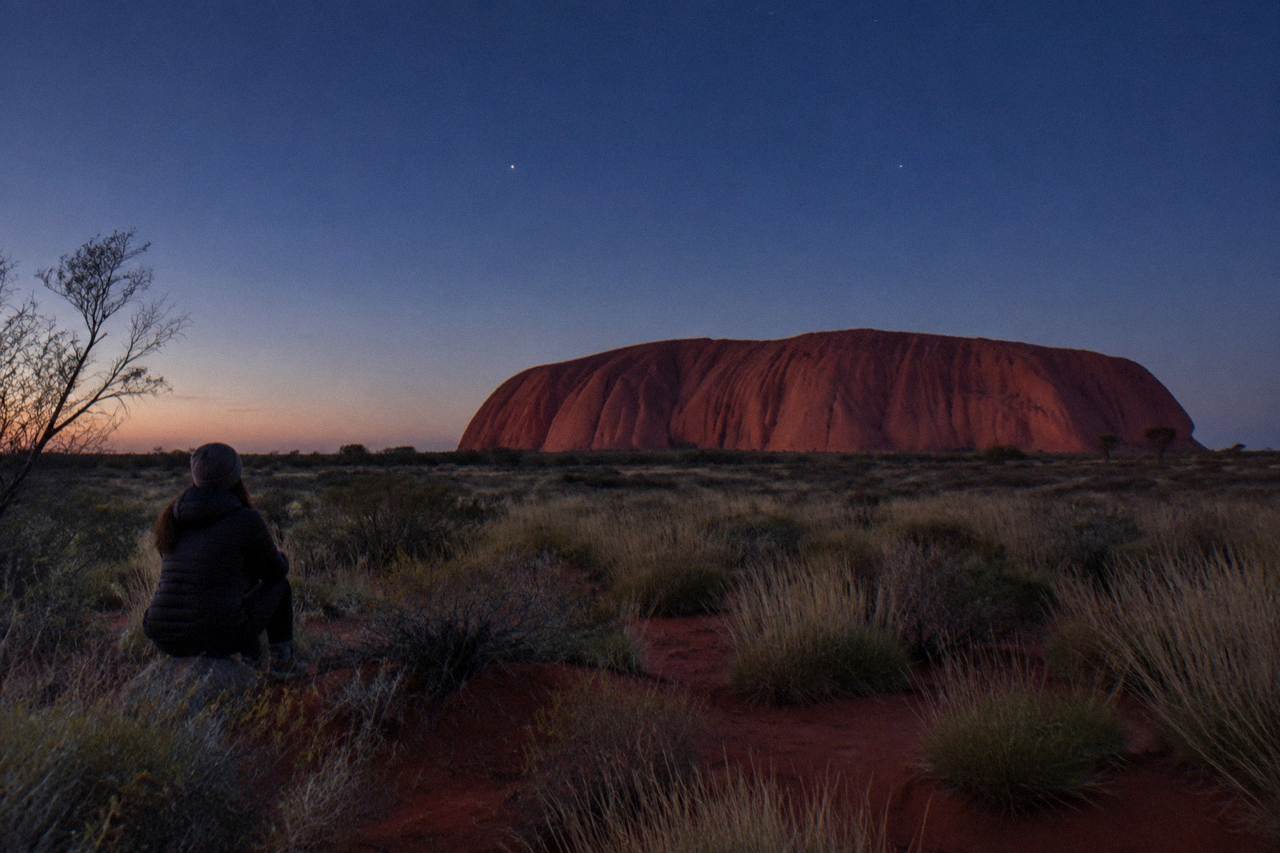
Dry air is the mechanism. Water vapour acts like a blanket that absorbs and re-radiates heat, and the Red Centre's humidity is low enough that once the sun drops, the ground radiates its warmth straight into the sky. Within two to four hours of sunset the temperature can fall 10 to 15 degrees, and the stillest, clearest nights are the coldest.
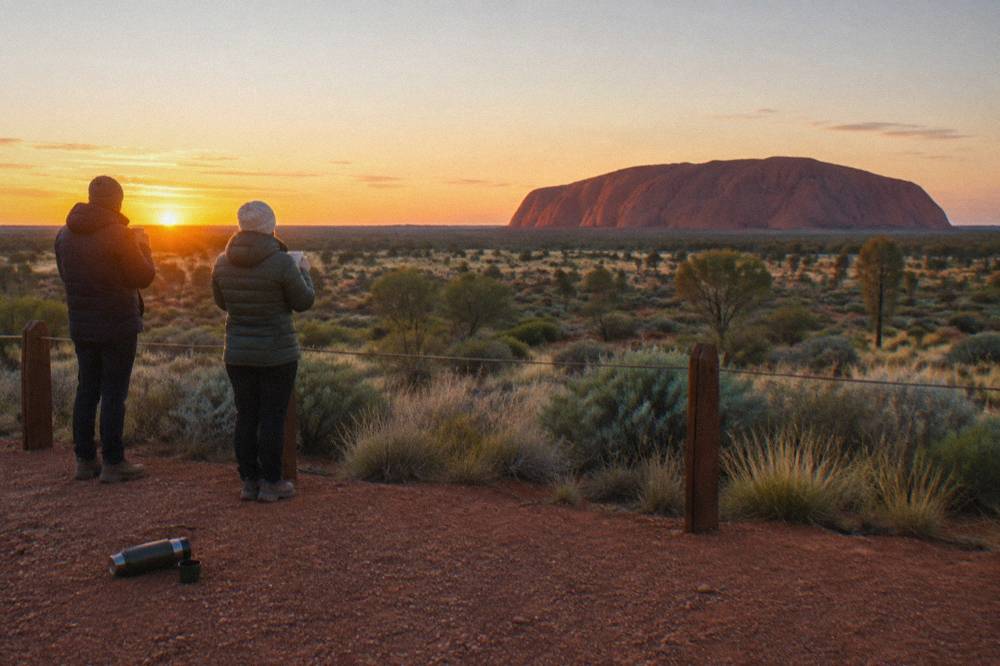
This is why the cold at Uluru feels different from a coastal cold snap. There is no wind chill off a cold ocean and no damp in the air, so 5 degrees in the desert feels closer to a crisp 5 degrees than a raw one, until you stand still in it for an hour. Standing still is precisely what sunrise viewing involves. The five dedicated viewing areas in the park, the sunrise platforms at Talinguru Nyakunytjaku and the Kata Tjuta dune and the sunset areas beside them, are open, exposed and slow places, and the park's own sunrise and sunset guidance describes all five on its sunrise and sunset page.
The same physics explains why the two daily extremes bracket every tour on the roster. Departures timed for first light leave the resort in the coldest hour, then the climb in temperature after sunrise is fast enough that by mid-morning the same walkers are stripping layers. Guides on the small-group tours plan around this rhythm, and the breakfast stops on tours like the Guided Sunrise Walk, Light Breakfast or the Kata Tjuta Sunrise, Breakfast tour land almost exactly when the morning starts to warm.
One more consequence of clear dry nights: they are spectacular. The night sky over the Centre is a genuine draw, and the park requires all visitors to leave by closing time, which is why the resort's night experiences, from the star talk that closes the Outback BBQ Dinner, Star Talk tour to the Sounds of Silence dinner, run on resort land rather than inside the park.
Which Months Are Coldest, And Which Nights Are Warmest?
July is the coldest month at 4.4 degrees average minimum, with June at 5.6 and August at 5.9 close behind. The warmest nights run December through February, averaging 20.8 to 22.8 degrees. May and September sit in between at 9.3 and 10.7 degrees, and April and October are the genuine swing months, cold early and mild late.
A season-by-season way to read it:
| Period | Night feel | What it means for visitors |
|---|---|---|
| December to February | Warm, 20 to 23 C average | Light clothing at night; daytime heat, not night cold, is the planning problem |
| March to April | Cooling, 14 to 19 C average | A light jacket for evenings; early April can feel wintry |
| May to August | Cold, 4 to 9 C average | Proper winter layers for any pre-dawn or evening activity; frost possible |
| September to October | Warming, 11 to 15 C average | Layers still needed at dawn; October mornings vary widely |
| November | Mild, 18.4 C average | Evenings pleasant; daytime heat returning |
Winter is also the peak visiting season, and that is not a coincidence. The same months with the coldest nights post daytime maxima of 20 to 24 degrees, which the park's planning pages describe as the best time to visit. Visitors who come for those perfect walking days are often caught out by the nights, packing for the brochure photo of red rock and blue sky and forgetting that the same dry air will have them reaching for a beanie at 6 am.
The Anangu seasonal calendar adds a finer grain than the calendar months. The piriyakutu, or piriya piriya, season usually runs August to October and is when food plants flower, a signal of warming weather on Country described on the park's seasons page. Bush flies are present from September to April, so the warming nights of spring come with a companion that winter visitors mostly escape.
How Does The Cold Affect Sunrise Tours And Field Of Light?
Every sunrise departure puts you outdoors in the day's coldest hour, the stretch before and after first light, when winter temperatures can sit between 2 and 8 degrees. Field of Light visits are the same: the Field of Light Sunrise Tour with Hot Drinks exists partly for this reason, pairing the pre-dawn viewing with a hot drink, and it carries a 4.6 rating from 677 reviews at from A$115 per person.
The tour names tell the story. Operators build warmth into the product because they know the conditions. The AAT Kings Field of Light sunrise product advertises hot drinks in its own title. The Highlights of Uluru Including Sunrise and Breakfast tour and the Kata Tjuta Small-Group Tour Including Sunrise and Breakfast both end with breakfast, which is as much about thawing as feeding. The Full Uluru Base Walk at Sunrise Including breakfast does the same for a six-hour walking commitment that starts in the dark. The full index of guides sits on Uluru Australia Tours.
The resort's own Field of Light products, sold direct by Ayers Rock Resort rather than through any tour listing here, follow identical logic. General Admission runs from $50 adult and $39 child, with the Star Pass from $137 adult and $87 child and the dinner experience from $360 adult and $180 child, for travel 1 April 2026 to 31 March 2027, as the resort's Field of Light page prints them. The installation, more than 50,000 spheres by artist Bruce Munro, has run since 2016 and is extended through 2029, and every one of those visits happens after dark in whatever the night is doing.
The practical guidance is simple and applies across every product: check the overnight forecast the evening before, wear one more layer than you think you need, and plan for the fact that you will be standing or sitting still for long stretches. Guided commentary is absorbing, but it does not generate heat.
The same cold-hour logic applies to the helicopter products, though with a twist. The 15-Minute Uluru Helicopter Experience and its longer stablemates are airborne and over quickly, so exposure is shorter, but the helipad wait before a dawn flight is an outdoor wait like any other. Layers you can shed in the aircraft work better than one heavy coat.
What Does The Cold Mean For Camping And Multi-Day Tours?
Camping in the winter months means nights that can drop to or below zero, and the camping tours on the roster are built for it with proper sleeping bags and swags, but you still need to arrive dressed for the reality. The Uluru, Kata Tjuta and Kings Canyon Camping Tour runs 3 days from A$795 per person and holds a 4.8 rating from 455 reviews, with free cancellation listed at a cutoff of 7 days before start.
The roster's camping family covers a range of commitment levels. The 3-day tour departs Yulara; the 3 night Uluru, Kata Tjuta and Kings Canyon Camping Adventure stretches to 4 days from A$1195 with a 4.9 rating from 355 reviews; and the 2-day Uluru-Kata Tjuta Overnight Camping tour runs from Alice Springs from A$765. Every one of them puts at least one night, and usually several, under desert skies.
A winter night on one of these tours is a different experience from a summer one. In June or July you will likely need the beanie and gloves while dinner is being cooked, and the coldest moment of the night is the pre-dawn wake-up, exactly when the best light is arriving. One guest review of the 4-day adventure calls it out as a highlight anyway: "Amazing experience! Sophie was a fantastic guide, with great knowledge. And a terrific cook! Highly recommended if you want to see the great sites and learn as well." Warren S's five stars are a fair signal that the cold does not ruin these trips for people who pack for it.
In the warmer half of the year the night problem inverts. Summer camping means nights warm enough to sleep lightly, but days the park's safety guidance is blunt about: temperatures can exceed 40 C, walking is discouraged between 2.30 pm and 6.30 pm, and the safe walking window is the cooler morning hours, finishing before 11.00 am in hot weather. The Bureau's current outlook for late 2026 leans toward above-average temperatures and rainfall for the southern Northern Territory, which makes both the winter-cold and summer-heat questions worth checking close to your travel dates on the official forecast for the area.
| Tour | Duration | From price | Night exposure |
|---|---|---|---|
| Uluru, Kata Tjuta and Kings Canyon Camping Tour | 3 days | A$795 | 2 nights outdoors, swag camping |
| 3 night Uluru, Kata Tjuta and Kings Canyon Camping Adventure | 4 days | A$1195 | 3 nights outdoors, swag camping |
| From Alice Springs: 2-Day Uluru-Kata Tjuta Overnight Camping | 2 days | A$765 | 1 night outdoors, departs Alice Springs |
| Field of Light Sunrise Tour with Hot Drinks | 2 hours | A$115 | Pre-dawn outdoors, hot drink included |
| Uluru (Ayers Rock) Sunset and Outback Barbecue Dinner and Star Talk | 3 hours 30 minutes | A$328 | Evening outdoors, includes star talk after dark |
The pattern across the table: any tour whose duration touches the hours of darkness carries night exposure, and the cancellation cutoffs differ tour by tour, from 24 hours on the Field of Light sunrise product to 7 days on the 3-day camping tour, so read the booking page for the specific tour you choose rather than assuming a standard rule.
How Should You Pack For Cold Nights And Early Starts?
Pack in layers around a warm mid-layer and a real jacket, plus a beanie, because winter mornings start near 5 degrees and warm past 20 by midday, and the only strategy that covers both is stripping layers as the sun climbs. Closed shoes, long trousers for evenings, and a warm top for sleeping are the camping additions. Expect the same day to need every layer you brought and then none of them.
A packing frame that maps to the numbers:
| Item | Winter (May to Aug) | Shoulder (Apr, Sep, Oct) | Summer (Nov to Mar) |
|---|---|---|---|
| Insulated jacket or warm fleece | Yes, essential at dawn and dusk | Yes, most mornings | Light layer only |
| Beanie and gloves | Yes for camping and sunrise | Beanie useful | Not needed |
| Long trousers | Evenings and mornings | Evenings | Optional, sun protection better reason |
| Warm sleepwear | Yes, plus warm socks for camping | For campers | Not needed |
| Sun protection | Yes, UV is extreme in warm months | Yes | Yes, essential |
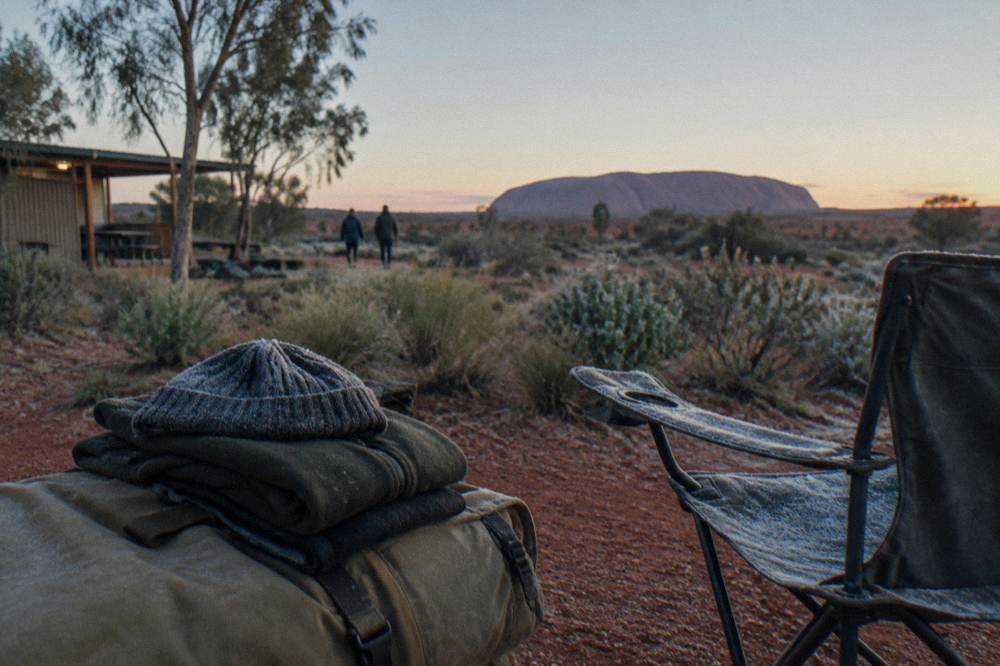
Two site-specific notes finish the picture. First, the same dry cold that chills the nights makes winter the most comfortable walking days of the year, and the free options are equally subject to it: the ranger-guided Mala walk starts at 8.00 am from October to April and 10.00 am from May to September, so even the free park activities are scheduled around temperature. Second, night-sky photography has a cold clause of its own: because all visitors must be out of the park by closing time, night shoots happen from outside it, typically the dune lookout on the Lasseter Highway, which means standing in the open in the coldest hours with a tripod. Photographers should plan gloves they can work camera controls in.
For readers comparing experiences rather than seasons, the deeper comparison of dawn versus dusk timing is covered in Is Uluru Better For Sunrise Or Sunset?, and the month-by-month trade-offs between cold, heat and crowds are laid out in the best time to visit guide. Both come back to the same core fact this article started with: the answer to how cold it gets is inseparable from when you go.
Does The Cold Ever Cancel Tours?
No listing on the roster advertises cold-weather cancellation, and the park itself closes walks for heat, not cold: the north-east walk closes from 11 am when temperatures reach 40 C, and the Lungkata walk closes from 2 pm in the same conditions. Cold nights are treated as a clothing problem for visitors, not an operational one. What does change operations is culture and weather, so conditions should always be checked before you travel.
The park occasionally closes entirely for cultural reasons, and the park's own news page is the authoritative place to check for that and for any track conditions before a visit, at the park news page. Tour operators likewise run to their own operational judgments, and weather, not temperature alone, decides whether a scenic flight or an outdoor dinner proceeds. Nobody can promise a clear sunrise or a calm evening, and honest planning treats every outdoor experience as weather-dependent.
Within that, winter's cold is dependable in a way summer's heat is not: it arrives on schedule almost every clear night and it is fully manageable with clothing. Operators know this, which is why the winter product line leans into breakfasts, hot drinks and star talks rather than into anything that fights the temperature. The Field of Light Sunrise Tour with Hot Drinks, reviewed earlier in this article, is the clearest example, and the same logic runs through the sunset dining products where the cold arrives mid-meal and a fire or a kitchen is part of the design.
Can You Touch Uluru?
Yes, you can stand beside Uluru and place a hand on the rock in places where no signage prohibits it, and the base walk passes close enough to do so, but culturally sensitive sections are signed and must be respected, and the climb is closed permanently. The rock itself is not forbidden to touch; specific sacred sites around it are.
This matters for a cold-night article because the base walk is a morning activity, and anyone walking the full 10 km circuit clockwise from the Mala carpark in winter starts in the coldest hour of the day. The Full Uluru Base Walk at Sunrise Including breakfast covers the whole circuit in a small group, runs 6 hours from A$249 and carries a 4.8 rating from 460 reviews. One guest review of it reads: "This was an excellent tour. The guide was incredibly knowledgeable and enjoyable. I would highly recommend this wonderful experience." Ian S's five-star note is one of 460, and it reflects a product built around starting cold and warming into the day.
The deeper questions of access, respect and the climb closure are covered properly in Can You Touch Uluru? and the Uluru climb ban guide, which explain the 2019 closure and what the EPBC Act means for anyone attempting the climb. For this article's purpose the link is simpler: walking the base in winter means an hour of cold standing and listening at the start, then several hours of comfortable walking, so the layering advice above applies in full.
Common Questions About Cold Nights At Uluru
Does It Get Cold At Night In Uluru?
Yes. Winter nights in June and July average lows of 5.6 and 4.4 degrees Celsius at Yulara, with frosts possible, while summer nights average 20.8 to 22.8 degrees. Every month of the year sees nights well below the daytime maximum.
How Cold Does Uluru Get In Winter?
The coldest month is July with an average minimum of 4.4 degrees Celsius, followed by June at 5.6 and August at 5.9. Individual clear nights can drop to or below zero, and frost on the ground is a regular winter occurrence.
Do I Need Warm Clothes For A Sunrise Tour At Uluru?
Yes, between May and September especially. Sunrise departures put you outdoors in the coldest hour of the day, often between 2 and 8 degrees in winter. A warm jacket, beanie and closed shoes are standard advice, and tours such as the Field of Light Sunrise Tour with Hot Drinks include a hot drink for exactly this reason.
Is Camping At Uluru Too Cold In Winter?
It is cold but manageable with proper gear. The camping tours on the roster provide swags and sleeping equipment, and winter campers should add a beanie, gloves and warm sleepwear. The coldest moment is usually the pre-dawn wake-up, which coincides with the best light.
Are Summer Nights At Uluru Warm?
Yes. December through February average overnight minima of 20.8 to 22.8 degrees Celsius. In summer the planning problem flips from cold nights to extreme daytime heat, with the park advising against walking between 2.30 pm and 6.30 pm.
Does It Ever Frost At Uluru?
Yes, frost on the red sand is a normal winter sight, particularly in June and July when average minima sit below 6 degrees and clear, still nights can push the temperature to or below zero.